June 25, 2026
Best Of: The Woman Who Demonstrated the Greenhouse Effect


June 25, 2026
Best Of: The Woman Who Demonstrated the Greenhouse Effect
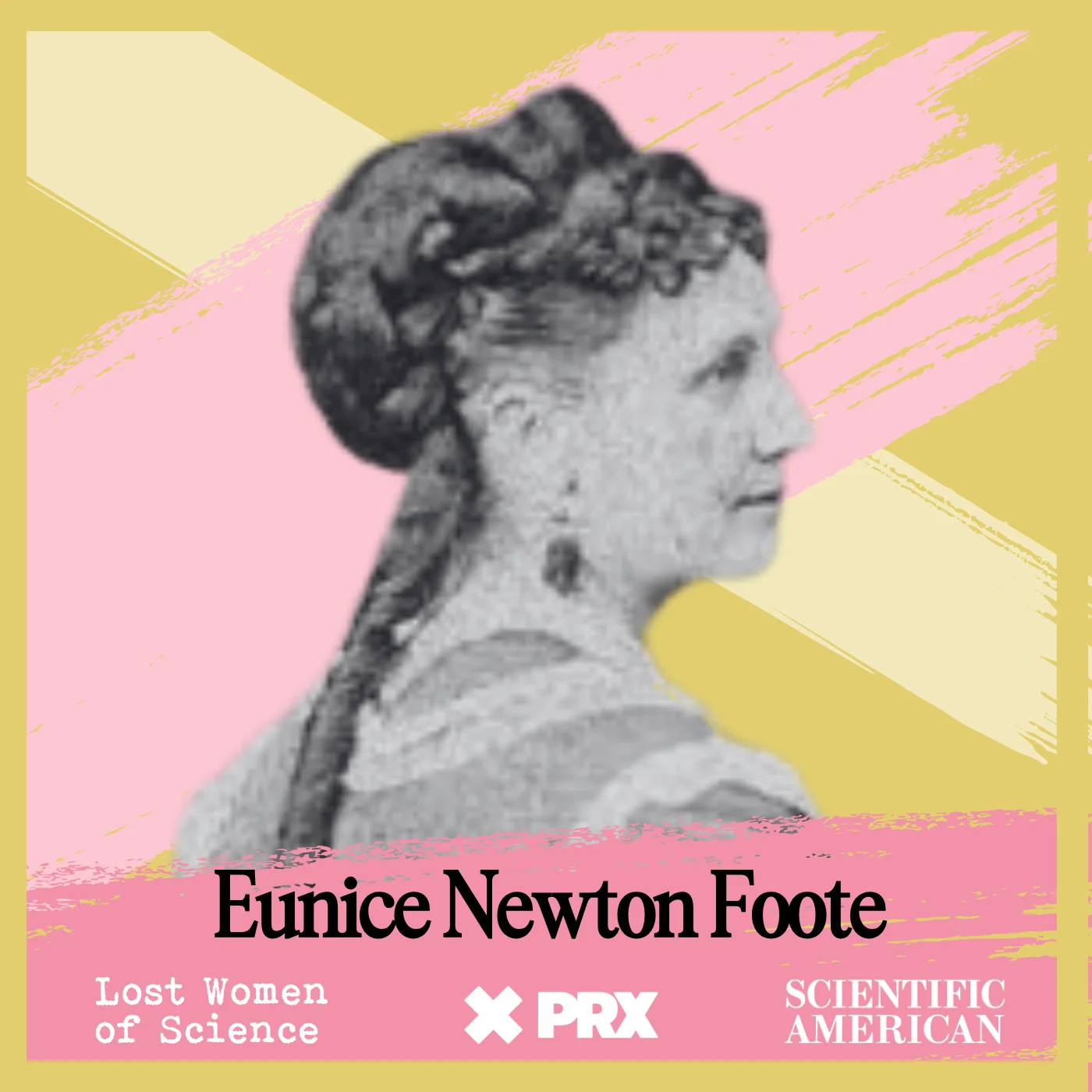
Eunice Newton Foote showed that carbon dioxide traps the heat of the sun in 1856, beating the so-called “father of the greenhouse effect” by at least three years. Why was she forgotten?
Episode Description
In 1856, decades before the term “greenhouse gas” was coined, Eunice Newton Foote demonstrated the greenhouse effect in her home laboratory. She placed a glass cylinder full of carbon dioxide in the sun, and found that it heated up much faster than a cylinder of ordinary air. Her conclusion: more carbon dioxide in the atmosphere results in a warmer planet.
Several years later, a British scientist named John Tyndall conducted a far more complicated experiment that demonstrated the same effect and revealed how it worked. Today, he’s widely known as the man who discovered the greenhouse gas effect. There’s even a crater on the moon named for him! Eunice Newton Foote, meanwhile, was lost to history—until an amateur historian stumbled on her story.


Zoe began her audio career working with the Kitchen Sisters on their podcast The Kitchen Sisters Present. After a stint in documentary film, she worked as an environmental reporter in West Texas covering everything from water shortages to cacti smuggling. She then moved on to KPCC/LAist Studios in Los Angeles where she worked on the daily news team and produced Weekend Edition. Zoe’s work has been featured on Marketplace and in New York Magazine, and she’s won two Regional Murrow Awards for her feature reporting.

Katie is co-founder and co-executive producer of The Lost Women of Science Initiative. She is the author of six non-fiction books and one novel, and was a longtime reporter for The New York Times. She is at work on her second novel.

Elah is a journalist, audio producer, and editor. Her work has appeared on Science Friday, Undiscovered, Science Diction, Planet Money, and various Canadian Broadcasting Company radio shows.
Zoe began her audio career working with the Kitchen Sisters on their podcast The Kitchen Sisters Present. After a stint in documentary film, she worked as an environmental reporter in West Texas covering everything from water shortages to cacti smuggling. She then moved on to KPCC/LAist Studios in Los Angeles where she worked on the daily news team and produced Weekend Edition. Zoe’s work has been featured on Marketplace and in New York Magazine, and she’s won two Regional Murrow Awards for her feature reporting.
Katie is co-founder and co-executive producer of The Lost Women of Science Initiative. She is the author of six non-fiction books and one novel, and was a longtime reporter for The New York Times. She is at work on her second novel.
Elah is a journalist, audio producer, and editor. Her work has appeared on Science Friday, Undiscovered, Science Diction, Planet Money, and various Canadian Broadcasting Company radio shows.
Retired petroleum geologist and amateur historian.
Science historian and professor emeritus at the University of Minnesota.
Author and lecturer who has been researching the story of Eunice Newton Foote
Climate scientist and chief scientist at the Nature Conservancy.


Further Reading:
The write-up of the 1856 talk at AAAS, where a man named Joseph Henry read Eunice’s paper for her.
Eunice’s full paper published in 1856.
Ray Sorenson, a retired petroleum geologist, uncovered Eunice Newton’s Foote story 12 years ago, and published this paper about his discovery.
“Who discovered the greenhouse effect?” an article from the Royal Institution asking what it means to “discover” the greenhouse effect when multiple people contributed to establishing it.
Episode Transcript
Best of: The Woman Who Demonstrated the Greenhouse Effect
Laura Gómez: About 12 years ago, Ray Sorenson was flipping through The Annual of Scientific Discovery of 1857. This is the kind of stuff Ray reads for fun, 19th Century science books and journals.
Ray Sorenson: You know, you buy a couple of those things, and you get hooked. I probably have a thousand publications that predate the Civil War.
Laura Gómez: The Annual of Scientific Discovery was kind of a yearbook of all the science happenings from the previous year. And as Ray was perusing this stimulating tome, as one does, one particular entry caught his attention. It was about experiments conducted by someone named Eunice Foote.
Ray Sorenson: Let’s see, where do I have it?
Laura Gómez: He’s going to read us a few lines once he finds it.
Ray Sorenson: Ah, here it is. I think. I need my reading glasses. Hold on.
Laura Gómez: So for context, what you’re about to hear is a write-up of a presentation of Eunice’s work that was given at a meeting in 1856. And Eunice didn’t get to read the paper herself at that meeting. A man actually read it for her. It was 1856, so you know.
Ray Sorenson: And I quote the whole thing: Professor Henry then read a paper by Mrs. Eunice Foote, prefacing it with a few words to the effect that science was of no country and of no sex. The sphere of woman embraces not only the beautiful and the useful, but the true. Mrs. Foote had determined first that the action… [fades]
Laura Gómez: The paper goes on to describe an experiment by this Eunice Foote, which she conducted in her home laboratory, showing that water vapor and carbon dioxide trapped more heat than other gasses. And her conclusion-
Ray Sorenson: An atmosphere of that gas would give to our earth a much higher temperature and if there once was… [fades]
Laura Gómez: Ray realized this unknown woman, Eunice Foote, had demonstrated the greenhouse gas effect in 1856. Which was odd because as far as most people knew, the person who first demonstrated it was someone named John Tyndall. He’s been called the father of the greenhouse effect or even the father of climate science. But John Tyndall started his experiments in 1859, and what Ray was looking at suggested Eunice had demonstrated the effect at least three years before that.
So who was this woman? And why had Ray heard of John Tyndall but not of her?
Ray Sorenson: There's no record of her. So I started digging around trying to find out stuff. And then I started thinking, okay, well she's, you know, if she's the first one to do this, she needs to be given credit for it.
Laura Gómez: Ray wrote up a short paper on his discovery, hoping it might inspire at least one researcher to dig into the history of Eunice Foote. It went far beyond that. He got one, then another, and another.
Ray Sorenson: It's almost becoming competitive! [Laughs]
Laura Gómez: And today, we throw our hat in the ring with the story of Eunice: how the mother of the greenhouse gas effect got lost and found.
Laura Gómez: This is Lost Women of Science. I’m Laura Gómez, and today we have the story of Eunice Newton Foote. It’s an adaptation of an episode that first aired in English in 2023.
Laura Gómez: In 1856, Scientific American described the work of a female scientist. They start with the obligatory – you know how people think women can’t do science? Well, guess what! Given the opportunity, some totally can! Not in those exact words, but that’s the gist. And their example? Mrs. Eunice Foote. The article goes on to describe Eunice’s recent experiments with gasses.
They write, quote, “The columns of the Scientific American have been oftentimes graced with articles on scientific subjects, by ladies, which would do honor to men of the highest scientific reputation; and the experiments of Mrs. Foot [sic] afford abundant evidence of the ability of woman to investigate any subject with originality and precision.”
Pretty glowing review of Eunice’s work.
So how did Eunice Newton Foote make this discovery, land a write up in the pages of the very prestigious Scientific American, and then get almost instantly overwritten by John Tyndall?
Let’s take a step back.
Eunice Newton was born in Goshen, Connecticut in 1819. Eunice’s father was a cattle runner, and Connecticut wasn’t exactly booming, so when Eunice was three years old, her father, Isaac — yes, his name was Isaac Newton -- her mother Thirza, and her ten brothers and sisters, hit the road in a covered wagon and headed to Bloomfield, New York. Which turned out to be a lucky move for Eunice.
Sally Kohlstedt (Doblaje):New York between 1830 and 1860. I mean, it was the progressive dynamo of- of much of the United States.
Laura Gómez: Sally Kohlstedt is a science historian and a professor emeritus at the University of Minnesota.
Sally Kohlstedt (Doblaje):That's where the Underground Railroad went through to Canada. You know, that's where all these utopian religions were founded and things like the Oneida community with mixed marriages. So whether it was sex or religion or science or civil rights, it was all, all being discussed there. It would've been fun to live there.
Laura Gómez: And Eunice’s family invested in her education. They even sent her to the first school in the country founded to provide young women with an education comparable to that of college-educated young men: The Troy Female Seminary.
And not only that, the Troy Female Seminary was right next to Rensselaer Polytechnic – the premiere science institute in the country at the time. And Troy students could go over there and take classes sometimes.
We’ve seen different accounts of exactly what age she was when she attended, but this would have been around the 1830s. A pretty big opportunity for a woman to get at the time.
Sally Kohlstedt (Doblaje):So she would have had a very unusual set of access points to sort of learn about and know what was going on.
Laura Gómez: But even with this education, there was a feeling among the students at the Troy Seminary, documented in their letters, that all of this science education was great, but it was also sort of a tease.
John Perlin: And the biggest complaint was, “What the hell, we’re learning all this scientific stuff and then when we graduate, all available to us will be, you know, looking pretty.”
Laura Gómez: John Perlin teaches physics at UC Santa Barbara. He’s writing a book about Eunice.
John Perlin: You know, what outlet would we have because of the times.
Laura Gómez: Even though the Troy School was different, these learned women still found themselves graduating into a world where they would be expected to cook and clean and needlepoint and smell nice and whatever. The “woman’s sphere” was still very much the “private sphere” -- the home. But Eunice managed to escape that life. In part, because of the man she married.
It all goes back to her father, Isaac Newton, the homesteader, and his perennial financial problems. Upstate New York hadn’t worked out much better than Connecticut for Isaac. He’d made some bad financial decisions, and then he passed away in 1835, leaving his family with a pile of debt. Soon, the Newton farm was about to go into foreclosure.
But Amanda, Eunice’s older sister, was like, I’m going to fix this and hired an attorney. One Elisha Foote.
John Perlin: He was ten years older than Eunice, and he was the district attorney of Seneca Falls. And he was moonlighting in Canandaigua where there was a federal court. And he took on their case, won it, and also won the hand of Eunice.
Laura Gómez: In 1841, Eunice and Elisha got married. She was twenty-two years old and he was thirty-two. And they moved to Seneca Falls, New York, where Eunice soon found herself in the epicenter of the American women’s rights movement. One of their neighbors was Elizabeth Cady Stanton, an early women’s rights organizer. Eunice got to know her just as Elizabeth’s star was beginning to rise.
They actually had a few connections. Elisha had studied law under Daniel Cady, Elizabeth’s father, and Eunice and Elizabeth had both attended the progressive Troy Female Seminary. We don’t know exactly how close they were, but living in Seneca Falls, they definitely knew each other.
Sally Kohlstedt (Doblaje):It's a very tiny town. You're really struck by how small the town is but therefore, how intimate it would've been for women to know each other.
Laura Gómez: So in 1848, when Elizabeth Cady Stanton co-organized the country’s first ever women’s rights convention right there in Seneca Falls, Eunice was there. Elisha too.
Three-hundred people in all attended, mostly locals. At the convention, Elizabeth Cady Stanton and Lucretia Mott presented the Declaration of Sentiments, a list of demands and resolutions to be put forward for signatures, demands like the right to vote. It was modeled after the Declaration of Independence. But in the opening, it says “We hold these truths to be self-evident: that all men and women are created equal” and that basically, women were fed up with the tyranny of men.
Eunice’s name appears in the ladies section, right under Elizabeth Cady Stanton’s, and Elisha’s in the gentlemen’s, right above Frederick Douglass.
So Eunice is in a really good place for a woman to be at this point in time.
Sally Kohlstedt (Doblaje): She was immersed in a world that accepted her that gave herself confidence, I think, and that took her seriously. I think that's the important point that I see as I look back at her life. I thought some part of it is you have to be really pretty brilliant and pretty smart and pretty persistent to do that kind of work. On the other hand, if you're not at all supported, it can be extremely tough. And she doesn't seem to have had that problem.
Laura Gómez: Okay, she’s an early feminist with a feminist husband. She has a great education. And then, she runs a little experiment in her home lab -- with huge ramifications.
That’s after the break.
BREAK
Laura Gómez: Elisha and Eunice were a bit of a power couple in Seneca Falls. They had a family together. They did feminism together. And they were both inventors and often collaborators. Among their inventions over the years were: a rubber shoe insert, a paper-making machine, an innovative ice skate… and an early thermostat for stoves. John Perlin again.
John Perlin: They mutually developed a metallic piece for the stove, which could tell when the cook stove was getting too hot or too cold, and it would, you know, either cause the metal to constrict or expand and that would change the draft of the stove.
Laura Gómez: We’ll come back to the stove shortly. But, beyond their inventions, they were also tapped into the world of scientific research and built themselves a home laboratory.
Sally Kohlstedt (Doblaje):The fact that she conducted her experiments at home, on the one hand, is very impressive.
Laura Gómez: Historian Sally Kohlstedt again.
Sally Kohlstedt (Doblaje):On the other hand, that was not an uncommon thing. Even in the very wealthy homes in England in the 19th century, they were doing what was called kind of estate science. Lord Kelvin, for example, did all of his work at home. So she was following a model of educated people who were just curious.
Laura Gómez: Curious about the big questions: How the planet worked. How it had changed over the years. A picture was emerging of a changing earth. Its rocks, its animals, and the temperature were all in flux.
Sally Kohlstedt (Doblaje):Somehow the dinosaurs lived in a different world where it was hotter, warmer, probably more moist, had a lot of ferns. And so she would have know that somehow the world had changed. What made it change? How did it work?
Laura Gómez: In 1856, Eunice set up a simple home experiment that would help answer that question.
Katharine Hayhoe: What she was interested in in 1856 was looking at the heat trapping properties of gasses.
Laura Gómez: That’s Katharine Hayhoe, a climate researcher and chief scientist at the nature conservancy.
Katharine Hayhoe: And she was aware that these heat trapping gasses like carbon dioxide were present in the atmosphere and she wanted to see what effect, um, energy from the sun had on those, as well as infrared energy.
Laura Gómez: Eunice got some glass cylinders, stuck a thermometer inside each one, and filled them up with different types of gasses. One cylinder had just regular air, so the usual mix of gasses found in our atmosphere. Another had just carbon dioxide. One had dry air, another humid air. And then, she put some in the sun and some in the shade.
And she found a few things. When exposed to sunlight, damp air got hotter than dry air. Oxygen heated up a bit more than hydrogen. But the biggest difference was between regular air and carbon dioxide. A tube of regular air in the sun heated up to 38 degrees Celsius; carbon dioxide shot up to 49.
So this was a fun, basic physics experiment. But Eunice was looking at the bigger picture: what this means for the planet. What if, at another point in time, the Earth’s atmosphere had more carbon dioxide in it? And here are her very words, written in 1856: An atmosphere of that gas would give to our earth a high temperature.
So, for background -- the real atmosphere is a mix of gases, mostly nitrogen. Carbon dioxide makes up a tiny proportion of it. But, Eunice concluded that if there was a little more or less carbon dioxide, it could shift the whole planet's temperature. And she also wrote that this could explain why the Earth had been warmer or colder at different points in its history.
Bottom line: more carbon dioxide meant a warmer climate.
Katharine Hayhoe: Which, as we now know, climate change is caused by heat trapping gasses building up in the atmosphere, essentially wrapping an extra blanket around the planet. I mean, that is such a basic, fundamental concept in climate science. And here she was in the 1850s, clearly explaining that to the scientists of the day.
Laura Gómez: So Eunice submitted her findings to the American Association for the Advancement of Science, or the AAAS, the country’s first national science association.
Back then, the AAAS was a traveling show – a roving meeting of science superstars, moving from major city to major city, spreading the word about new scientific advancements and discoveries. They’d be greeted with feasts and fanfare, and just a lot of excitement.
Sally Kohlstedt (Doblaje):It was the place if you wanted to meet and greet other people who were in your field. Also, you wanted to get your ideas out because the papers were gonna cover it. Your ideas would get out in public to the larger public as well as in the proceedings if you were published there. So yes, it was the place to go.
Laura Gómez: But science was still a total boys club, and the AAAS was no exception. Women were allowed in the audience, but a woman had never presented before.
Sally Kohlstedt (Doblaje):Men's domain was the public domain. Women's domain was the domestic domain. So a woman who spoke out — and there were certainly some women who were quote “notorious” because they did public speaking — speaking out in public could be a negative on your capacity to be recognized and prominent in social circles. So women were sort of policing themselves as much as they were being policed.
Laura Gómez: This is actually a really relatable feeling even if it’s not the same level as it was back in the 1800s. I still feel that impulse to make myself small or be modest in certain situations. So I can only imagine how Eunice might have felt back then.
Sally Kohlstedt (Doblaje):And so she very well might have been hesitant to present the material herself because that wouldn't have been womanly. But she could ask Joseph Henry to do it.
Laura Gómez: Eunice’s husband, Elisha, had studied with a man named Joseph Henry, a physicist and one of the science luminaries of the day, well not just a luminary, actually.
Sally Kohlstedt (Doblaje):Joseph Henry was the guy. He was the secretary of the Smithsonian Institution. And the Smithsonian Institution in the 1850s was the leading scientific organization in the country.
Laura Gómez: So why would Joseph Henry agree to present Eunice’s paper? We’re not sure, but Joseph Henry had four daughters and no sons.
Sally Kohlstedt (Doblaje):He very well may have appreciated what young women could do. On the other hand, he's no feminist. So I think he has kind of ambivalent feelings about women in their capacity. And so he probably appreciated the fact that she was gonna be reticent to do her own paper, but also had a brain that was worth listening to.
Laura Gómez: So one August day in Albany, Eunice walked into the AAAS convention, took her seat alongside America’s elite scientists, and watched a man present her research.
In what seems to be the style of the time, Joseph Henry started off with the obligatory acknowledgement that this was the work of a woman scientist and women can do science. And then went on to describe her experiment.
Eunice’s paper didn’t make it into the official conference proceedings, but she formally published it a few months later, and her research made a bit of a splash.
She got a write-up in the Annual of Scientific Discovery, where Ray Sorenson first came across her, and she made it into a German publication, where they mistook her for a man, calling her Mr. Foote.
And of course, she had that glowing writeup in Scientific American. But that’s kind of it. She fades away. You don’t see her popping up in scientific journals, and certainly no one’s calling her the “mother of climate science.”
Laura Gómez: And then, a few years after Eunice published her research, an Irish scientist named John Tyndall started looking into similar questions.
Sally Kohlstedt (Doblaje):As I understand Tyndall, he's a very egotistical kind of guy. He's a very busy guy. He's making money as a lecturer and doing other things.
Laura Gómez: John Tyndall was working as a professor of natural philosophy at The Royal Institution in London, publishing research in European journals. And we’re not sure to what extent he was paying attention to what Eunice was up to across the pond, or vice versa, but-
Sally Kohlstedt (Doblaje):There's a lot of international exchange. At the same time, these Americans are still feeling a little bit like the little brother.
Laura Gómez: So in the late 1850s, John cooked up an experiment of his own, and the basic ingredients were a lot like Eunice’s: gases, heat and thermometers. But if Eunice’s backyard experiment was a kind of a Toyota Camry — reliable, simple, a good starting point — John Tyndall’s experiment was a Rolls Royce.
He had all of the big-time equipment of the day, assistants helping him in the lab, and all of that helped him do something Eunice wasn’t able to do. Because even though Eunice had demonstrated the greenhouse gas effect, she didn’t know why it was happening. Why did some gases heat up so much more than others? That’s where John Tyndall comes in.
John was able to take Eunice’s experiment to the next level. Instead of putting his gases in the sun, his heat source was a copper cube filled with boiling water. Like any hot object, it was giving off radiant heat — what we’d now call long-wave infrared radiation.
Every object that contains heat radiates it out — you, your shoes, the earth. And greenhouse gases are ones that are extra good at absorbing that radiated heat. Tyndall was able to figure that out. He could measure how much radiation they were absorbing using a spectrometer he built himself. He also showed that sunlight could easily pass through gasses.
And so while Eunice could only say that for some reason gases got extra hot in the sun, John Tyndall figured out why.
As he wrote: "The atmosphere admits of the entrance of the solar heat, but checks its exit, and the result is a tendency to accumulate heat at the surface of the planet."
And like Eunice, he later wrote that changing concentrations of these gases would explain the fluctuating temperatures of the planet. So points to John Tyndall! But still, Eunice, with her very basic home lab, figured out that these gases trapped heat and deduced the implications for the planet. I mean, she demonstrated the greenhouse gas effect before John Tyndall.
Sally Kohlstedt (Doblaje):What's interesting is the contrast between his operation and her operation in her own home, working with very limited equipment, and yet she does reach this significant conclusion, so I find that makes her even more interesting.
Laura Gómez: Historians can’t agree on whether or not John Tyndall knew about Eunice’s work. John Perlin is convinced that he was. They were clearly interested in similar topics. There was some overlap in where they were publishing. And in one case, John Tyndall was editing a magazine that reprinted an article by Elisha Foote, and that article had originally appeared right next to Eunice’s paper.
So it’s at least very possible that he saw her work and maybe got a little bit of an idea. And that’s fine — scientists are sometimes inspired by one another — but we do know of at least one other instance where John Tyndall failed to credit someone’s influence on his work. He was actually called out for it in a national magazine that accused him of stealing credit from our dear friend Joseph Henry. That time, the dispute was about research on sound waves. But still, that doesn’t look great for his case with Eunice.
Sally Kohlstedt (Doblaje):On the other hand, in the history of science, there's a lot of what we call simultaneous discoveries. Sometimes at two different places in two different ways, two scholars do the same thing. People have written books about simultaneous discovery. So, so that goes on. And so it's possible that Tyndall was there asking many of the same questions because those are the questions.
Laura Gómez: And by the way, if we’re going to debate who gets credit for discovering the greenhouse gas effect, well, John and Eunice have some competition.
In 1824 — so three decades before either of their experiments — the mathematician Joseph Fourier was thinking about the surface of the Earth, why it isn’t much colder. He figured it should be freezing, floating around in space. The heat it was getting from the sun alone couldn’t explain how warm it was. Or the heat from inside the earth. So what was it? The answer: the atmosphere. An insulating blanket that let the heat of the sun in and then trapped it inside.
He didn’t offer any equations. It was yet another scientist, Claude Pouillet, who actually crunched some numbers a decade later. So you have Joseph figuring out that the atmosphere traps heat, then Claude doing the math, then Eunice Foote actually demonstrating that some gases trap more heat than others. And then John Tyndall figuring out why. And that’s not even the whole list of people who contributed to the concept of greenhouse gases. So who quote “discovered” the greenhouse gas effect? Who gets credit for being first?
It’s not easy to answer. But the least we can do is acknowledge people’s contributions. And John Tyndall, in the opening paper, did note the contributions of Joseph Fourier, Claude Pouillet, and a couple of others. He did not mention Eunice Newton Foote. So why would he do that? Well, there’s always the chance he really hadn’t heard of her. She had a few factors working against her.
Sally Kohlstedt (Doblaje):She was rural, she was not connected, she was a woman, she was in America. All of those things probably contributed to a certain amount of invisibility.
Laura Gómez: Another factor working against her? By the time John Tyndall had published his paper, Eunice had moved on. She was looking at other scientific questions. A year after Joseph Henry presented her paper at AAAS, he presented another paper from Eunice about how air generated static electricity.
Eunice might have also been distracted by a big lawsuit Elisha had undertaken on their behalf. Remember that stove thermostat they invented? Well, they had a patent for that, but a lot of people were interested in thermostats back then.
John Perlin: All these people start to infringe on the patent.
Laura Gómez: John Perlin again.
John Perlin: And Elisha, who was an attorney, took the case of all these infringers, all the way up to the Supreme Court. And so Elisha wins the case, right? And so all these people who were infringers were forced to give the Footes, you know, all the money that they received in profits from stealing the invention.
Laura Gómez: The defendants were ordered to pay the Footes over sixty-thousand dollars. That’s today’s equivalent of over 2 million dollars.
John Perlin: So Eunice turns from scientist to becoming the matron of wealth.
Laura Gómez: And at this point, no one’s talking about the great scientist Eunice Newton Foote. And there aren’t many records of more science that Eunice did, besides that one presentation at AAAS. But she continued inventing into her forties. She filed a patent in her own name on that rubber shoe insert -- it was intended to quote “prevent the squeaking of boots and shoes." She’s very practical.
She also developed a new cylinder-type of paper-making machine that lowered the cost of manufacturing. And if she didn’t have a life of scientific glory, it sounds like she still had an intellectually stimulating life, and a wonderfully ordinary one.
In a letter archived by the Smithsonian written in the 1870s, Eunice wrote to her daughter. In the letter, she talks about buying dresses, spending time with her grandson, running her household, and finding the dining room girl dead drunk on the floor. She’s just thinking about regular degular, mundane, sometimes gossipy, life stuff.
Sally Kohlstedt (Doblaje):Ultimately, my assumption is that she followed her own instincts. Created a good life, but wasn't interested necessarily in becoming someone who could be called the mother of anything in terms of science itself. Uh, but she wanted to make a contribution. I mean, that's kind of the way most of those 19th-century scientists thought. Can I make a contribution to knowledge?
Laura Gómez: Like, as you know, she was curious about things. She had a home laboratory. She was able to patent stuff. And she had a supportive husband, two daughters and grandkids. She had a life that made sense to her. And I don't know that she wanted for anything else.
Eunice Newton Foote died in 1888 at age 69, a few years after Elisha. And for more than a century, she was almost entirely forgotten… even as John Tyndall’s legacy lived on. There’s Tyndall National Institute in Ireland, the Tyndall Centre for Climate Change Research in the U.K., Mount Tyndall in California and Mount Tyndall, again, in Australia, the Tyndall Glaciers in Colorado and Chile. He even got a crater on the moon named after him.
But thanks to Ray Sorensen and the many enthusiasts that have followed, Eunice is finally getting her day. Her name is out there. Like, really, out there. On a break between reading scientific journals from the 1800s, Ray Sorenson was watching Jeopardy and-
Ray Sorenson: I saw something about women scientists, so I paid attention to it.
Jeopardy Contestant 1: Women of science 400.
Laura Gómez: And he heard a familiar name.
Ken Jennings: Eunice Foote's circumstances affecting the heat of the sun's rays foreshadowed the study of this effect. // Vince.
Laura Gómez: It was a question about what effect could be traced back to the work of Eunice Foote.
Jeopardy Contestant 1: What is the greenhouse effect?
Laura Gómez: The greenhouse effect.
Ray Sorenson: That's probably the single biggest highlight. My name did not get mentioned in the Jeopardy episode, but yeah, that's okay.
Laura Gómez: This episode of Lost Women of Science was originally produced in English by Zoe Kurland, with help from senior producer Elah Feder.
I was the host, translator, and producer of the version in Spanish. David De Luca adapted the sound design. Our associate producer was Natalia Sánchez Loayza. Samia Bouzid was our senior producer, and our senior managing producer was Deborah Unger.
Our co-executive producers are Amy Scharf and Katie Hafner. Our program manager is Eowyn Burtner.
The original episode in English was co-hosted by Zoe Kurland and Katie Hafner. It was sound designed by Rebecca Cunningham and mastered by Hansdale Hsu. Our fact checker was Danya AbdelHameid. Lizzy Younan composed all of our music.
Special thanks to Martha Weiss for contacting us about Eunice Newton Foote in the first place.
Lost Women of Science is funded in part by the Alfred P. Sloan Foundation and the Anne Wojcicki Foundation. We're distributed by PRX.
You can find more information and a transcript of this episode at lostwomenofscience.org. I’m your host, Laura Gómez. Thanks for listening.
Listen to the Next Episode in this Series
More Episodes
Listen to the complete collection of episodes in this series.