March 19, 2026
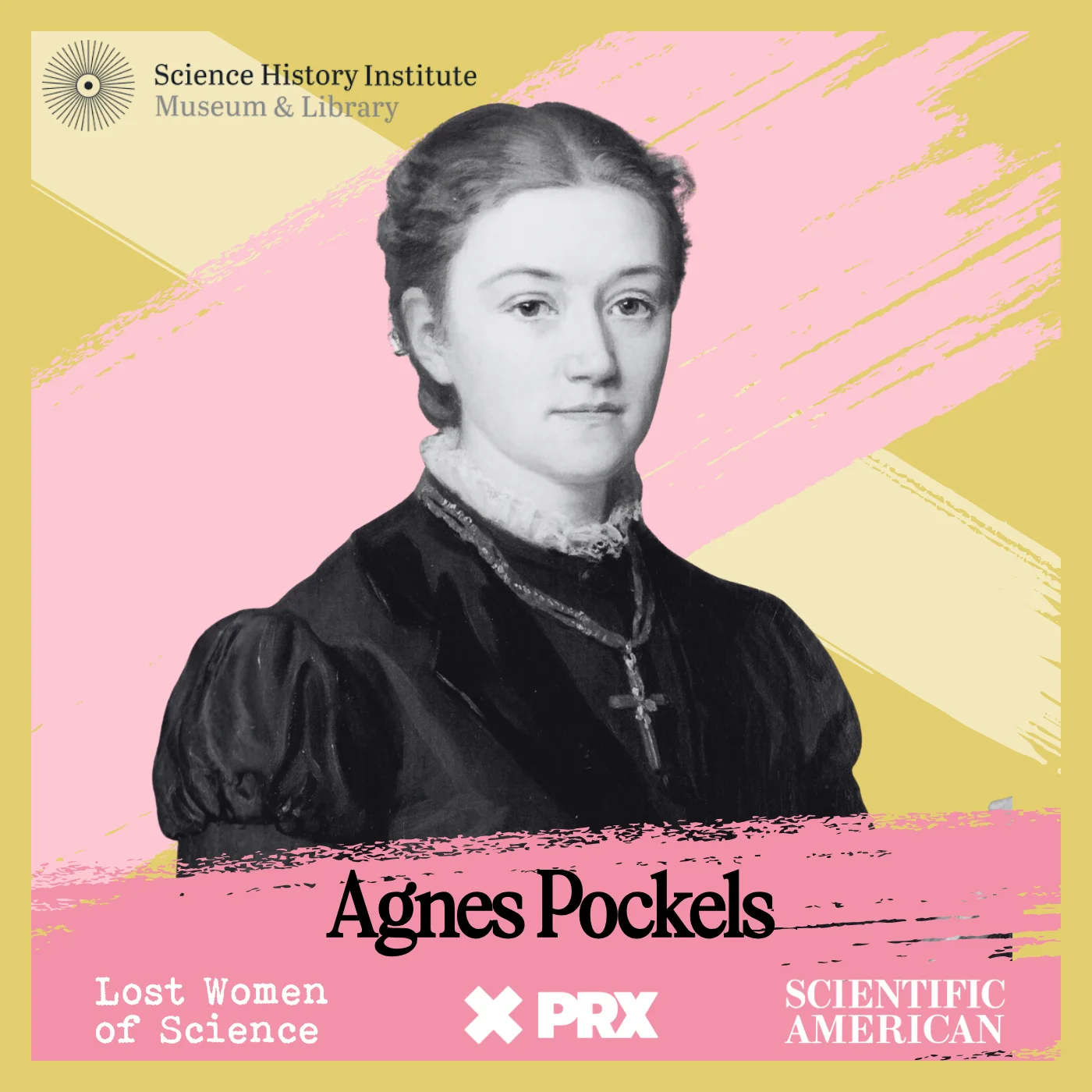
BONUS: Agnes Pockels and the Kitchen Sink Myth


March 19, 2026
BONUS: Agnes Pockels and the Kitchen Sink Myth
Was she doing the dishes or science?
Episode Description
This bonus episode is a co-production with Distillations, a podcast produced by the Science History Institute.
Agnes Pockels did pioneering work in surface science. Her invention, the Pockels Trough, became the basis for an instrument that helped Katherine Burr Blodgett and Irving Langmuir make discoveries in material science that quietly shape our everyday world.
But the way we talk about Agnes’s life and work often falls back on familiar tropes about women’s domestic roles, assumptions about how science gets done, and what it looked like to do science as a woman in the 19th century.
Agnes's story invites us to rethink how we define success for scientists. Is our definition too narrow? And what might we gain if we crack it open a bit wider?

.webp)
As chief storyteller and podcast host at the Science History Institute, Alexis Pedrick oversees the creative team responsible for all major podcasts produced by the Institute, including Distillations. Alexis is known for her lively history talks and tours in Philadelphia.
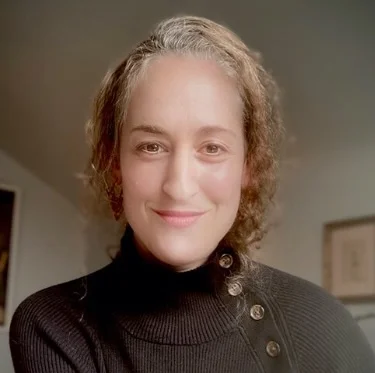
Mariel is the executive producer of the Distillations podcast and videos. Mariel has previously worked as a video and radio producer at KALW radio in San Francisco and PBS’s Frontline, and as a teaching artist at the Philadelphia Museum of Art.

Sophia Levin is a journalist and teacher based in Washington, D.C. and Pittsburgh, PA. She has written about unions, infrastructure, and reproductive healthcare for The Tartan and PublicSource. She holds a bachelor’s degree in Creative Writing and History from Carnegie Mellon University.
As chief storyteller and podcast host at the Science History Institute, Alexis Pedrick oversees the creative team responsible for all major podcasts produced by the Institute, including Distillations. Alexis is known for her lively history talks and tours in Philadelphia.
Mariel is the executive producer of the Distillations podcast and videos. Mariel has previously worked as a video and radio producer at KALW radio in San Francisco and PBS’s Frontline, and as a teaching artist at the Philadelphia Museum of Art.
Sophia Levin is a journalist and teacher based in Washington, D.C. and Pittsburgh, PA. She has written about unions, infrastructure, and reproductive healthcare for The Tartan and PublicSource. She holds a bachelor’s degree in Creative Writing and History from Carnegie Mellon University.
Brigitte Van Tiggelen is the Science History Institute’s director of international affairs, working from the Institute’s office in Paris. Trained as both a physicist and a historian, she is the coeditor of Women in Their Element: Selected Women’s Contributions to the Periodic System (2019), a volume that brings together more than two decades of research and publication of the life and work of women in science.
Donald L. Opitz is a historian of science who teaches in the School of Continuing and Professional Studies and Department of History at DePaul University. He is writing a book that traces the international movement for the advancement of women in agriculture and horticulture from the mid-nineteenth to mid-twentieth centuries.
Petra Mischnick was a professor of food chemistry at Technische Universität Braunschweig, Germany. There she founded and ran the Agnes Pockels Student Lab to inspire young children, especially girls, to pursue science.


Further Reading:
Kohlstedt, Sally Gregory and Opitz, Don. “Agnes Pockels - Surface Chemist and ‘Hausfrau,’” The Changing Images of the Sciences. 2002.
Pockels, Agnes. On the Relative Contamination of the Water-Surface by Equal Quantities of Different Substances. Nature, 1892.
Sella, Andrea. Pockels’ Trough. Chemistry World, 2015.
Tiggelen, Brigitte Van.”Fräulein Agnes Pockels: the shaping of a ‘forschende Hausfrau,’” paper presented at the 24th International Congress of History of Science, Technology, and Medicine.
Bergwik, Staffan; Opitz, Donald L.; Tiggelen, Brigitte. Domesticity in the Making of Modern Science. 2016.
Episode Transcript
BONUS: Agnes Pockels and the Kitchen Sink Myth
Alexis Pedrick: From the Science History Institute in collaboration with Lost Women of Science, for a special joint episode, I'm Alexis Pedrick, and this is Distillations.
Lost Women of Science just launched their new season, Layers of Brilliance, all about Katharine Burr Blodgett, a scientist whose discoveries in material science quietly shape our everyday world.
Blodgett started working for General Electric in 1918. The science she did there led to multiple US patents and formed the basis of technologies we now use in our screens and electronics. But Blodgett's legacy has long been eclipsed by the famous scientist she worked with, Irving Langmuir. So where do we come in?
Well, Blodgett and Langmuir's experiments used a version of an instrument originally invented by an earlier scientist, a woman named Agnes Pockels, and this episode is all about her.
In 1891, the esteemed international weekly science journal, Nature, did something unusual. They published a letter written by a woman. Her name was Agnes Pockels, and her letter was addressed to a man in England known as Lord Rayleigh. Now Lord Rayleigh or John Strutt, the third Baron Rayleigh, was what's known as a hereditary peer.
I've been informed that not everyone reads as much historical romance as I do, and therefore might not be familiar with this term. It just means he inherited his title through his family lineage and was entitled to sit in the House of Lords. Very fancy.
Lord Rayleigh was also a physicist. He would go on to win the Nobel Prize in Physics in 1904. And all of this is to say that he had the kind of clout that could encourage the journal's editor to publish a letter written by a woman.
Now, Agnes had written to Lord Rayleigh after learning that he was doing experiments on what is now known as surface science. Surface science is the study of the boundary line where two different phases of matter meet––think where solid meets a liquid or liquid meets a gas. These meeting points are often highly reactive, and the outermost layer of molecules act in really unique ways that can be useful to us. Take dish soap, for example. It's an intermediary between water and grease. Why does it work? Because it reduces the surface tension of the water to get at the dirt. Surface science is fundamental to everything from catalytic converters to computer chips to water filtration. It even comes into play with medical implants. So now you're up to date on the science Agnes was working on.
She began her letter to Lord Rayleigh by saying:
Frauke Levin reading Agnes Pockels’ letter: My Lord, will you kindly excuse my venturing to trouble you with a German letter on a scientific subject? Having heard of the fruitful researches carried on by you last year on the hitherto little understood properties of water surfaces. I thought it might interest you to know of my own observations on the subject.
Alexis Pedrick: What observations? And how did Lord Rayleigh respond? Well, to answer that, we should bring in some backup.
Brigitte Van Tiggelen: So I'm Brigitte Van Tiggelen, but you can call me "Brigitte" or "Bridget" or "Bridgetta"...
Alexis Pedrick: Brigitte is our colleague here at the Science History Institute. She's the Director of International Affairs now, but she started as a research fellow, and she specializes in women and couples in science, including Agnes Pockels. We asked her what happened when Lord Rayleigh received Agnes' letter.
Brigitte Van Tiggelen: Lord Rayleigh is really interested in what Agnes Pockels is doing. Of course, he's also intrigued by the fact that she might be a lady. He's not very sure, but he's mostly interested in the experimental device that Agnes was able to build.
Alexis Pedrick: Agnes hadn't merely made observations. She built her own instrument to measure them. Eventually, that instrument, the Pockels Trough, became the basis for the modern Langmuir-Blodgett trough, which helped Irving Langmuir do the work in surface chemistry that won him a Nobel Prize in 1932. Lord Rayleigh saw how impressive Agnes's instrument was immediately.
Brigitte Van Tiggelen: He actually asks Agnes, could you please make one for me and send it to me? And she says, well, you know, this is difficult. I build it, you know, petite à petit, you know, step by step myself. And I can't remake another one, but I can give you the details. In the end, Lord Rayleigh recognizes that her experimental device is better than what he was using, and he kind of will use it in further research.
Alexis Pedrick: Maybe you think you know where this story is going, that I'm about to tell you how Agnes Pockels busted through barriers and became the "Marie Curie" of surface science. Or that she had her accomplishments unceremoniously stripped from the record, and we're just now giving her her due. Such is the plight of many a female scientist from the past who we've lost sight of. But, I'm not here to tell you either of those things. Instead, I'm going to tell you that Agnes' story is complicated and that if her legacy has been lost, it might be because our own assumptions, and 21st-century way of looking at the world got in our way.
Agnes's story begs us to think about how we define success as a scientist. Is it becoming a tenured professor? Winning a Nobel Prize? What about inventing or discovering something that makes the world a better place? Agnes's story makes us ask if our definition of success is too narrow. And what do we stand to gain if we crack it open a bit wider?
Chapter One: Agnes's Discovery.
If I had to choose one word to sum up how we usually tell the story of Agnes Pockels, I would pick "assumption," or rather "assumptions," plural. We make a lot of them about Agnes's life, starting with the very first thing we learn about her.
So without further ado, I present Assumption Number One: the quirky story of Agnes's discovery makes sense for a woman of her time. When we first started working on this episode, almost every source we read on the internet tells the story of how Agnes became interested in surface science by observing the behavior of soapy water while doing the dishes.
Brigitte Van Tiggelen: She gets interested in what happens at the surface of water––it could be soil water, it could be oil, it could be all kinds of things––behavior under changing circumstances.
Alexis Pedrick: It's a tidy story. Agnes observed how soap behaved at the surface of water, and boom! Revelation. It's like other discovery stories we celebrate: Isaac Newton getting bonked on the head with an apple and then, boom, in a flash, he formulates gravitational theory. But neither of these stories are accurate, and they obscure how science actually gets done in deliberate, active ways. It's not just people walking around getting hit on the heads––literally. We reached out to one of Bridget's colleagues to hear his take on the dishwashing story.
Don Opitz: I'm Don, and I'm an associate professor at DePaul University with affiliations in the School of Continuing and Professional Studies, the History Department, and LGBTQ studies. I probably should say I'm also an historian of science.
Alexis Pedrick: Don was studying Lord Rayleigh in graduate school when a fellow student asked him a question that changed the course of his research.
Don Opitz: She randomly asked me, did any women influence Lord Rayleigh's science? And I'm like, I don't know. So I decided to answer that question.
Alexis Pedrick: That's how he came to learn about Agnes Pockels, and primary sources led him to realize pretty quickly that the whole "woman has discovery while doing the dishes" story was probably worth questioning.
Don Opitz: You know, and there's pictures of the house they lived in, and it's a pretty prominent-looking house, substantial looking house––surely, they had domestic help. That would have been pretty standard for someone of their class. So now, in general, in history, and historians of science even more so, don't talk a lot about domestic staff in their histories. I think it's starting to change now, but surely there was domestic staff also in that household. So, how much she actually did the dishes, I think, is open to question.
Alexis Pedrick: But if she really did do the dishes, what's the problem? Well, think about how we tell the dishes story. It makes it seem like Agnes just fell into doing science one day. But this couldn't be further from the truth. And to explain, we have to go back to the beginning.
Chapter Two: Agnes's Early Years.
Agnes Louise Wilhelmine Pockels was born in 1862 in Venice. At that time, Venice was part of the Austrian Empire, and Agnes's father served in the army. When he fell sick with malaria in 1871, Agnes's family moved to Braunschweig, which was part of the brand-new German Empire.
Petra Mishnik: So she was nine years old when she came to Braunschweig.
Alexis Pedrick: This is Petra Mishnik, a retired professor from the Technical University of Braunschweig.
Petra Mishnik: But at that time, for girls, there was no possibility to go to university. That was not allowed. But she was so strongly interested in natural science that she learned a lot, like how to deduct and so on.
Alexis Pedrick: Agnes attended the Municipal High School for Girls.
Petra Mishnik: So, what she learned is mainly focused on languages and textile work and maybe music, literature--these things that seems to be what young women should learn.
Brigitte Van Tiggelen: So it was a family where you were not only expected to be keeping the household or raising kids or taking care of relatives, but you were also supposed to have conversation skills, to be educated, to be interested and passionate about something, mostly intellectual pursuits.
Alexis Pedrick: Her curriculum was pretty standard for a young woman of her class. She was learning all the skills she'd need to be a future governess of her house. And you can side-eye that statement, but running a household was no joke. You had to manage staff, keep budgets, have the skill set to host society gatherings where you were required to hold intellectual conversations. And all the while, Agnes kept pursuing science on her own.
All of this makes me think back to the kitchen sink story. Maybe Agnes truly did make scientific observations while doing the dishes, but isn't it more likely that she went to the sink with the intention of making scientific observations?
Brigitte Van Tiggelen: She was a curious, inquisitive mind, and she observed something that didn't make complete sense, but didn't make complete sense for someone who was already educated and aware of what science is and how the natural world follows rules and so on.
Alexis Pedrick: Agnes had a younger brother, Friedrich or Fritz, who was three years her junior. He also loved science and eventually studied physics at the University of Göttingen. Now, this is important for some practical reasons. For one, Fritz shared his textbooks with Agnes so she could study on her own. But we wanted to hear Brigitte's take on their relationship before we made any assumptions.
I was wondering if you could talk a little bit more about that, about the siblings sort of doing science together growing up?
Brigitte Van Tiggelen: Yeah, I really like this question because a trope in the history of women in science is that women are always introduced or supported because there's a family member. It can be a father, a husband, a lover, a close friend, a son, a brother, a cousin, whatever. So they only exist in the scientific community by proxy, and I find that very sad to really keep this view. Sometimes it applies, but sometimes it does not.
Alexis Pedrick: Which brings us to Assumption Number Two: that Fritz influenced Agnes scientifically. Brigitte flipped that assumption on its head.
Brigitte Van Tiggelen: In the case of Agnes and Fritz, Agnes is the oldest. She's the eldest––sorry. And he's two or three years younger. So that's a difference when you grow up as siblings, especially in the teenage years, right? Which means that probably, more probably than not, Agnes had an influence on her brother, maybe even in the choice of a career in science and in supporting that career in all the ways she could offer.
Alexis Pedrick: From a distance, you can see why the tendency might be to assume that Fritz was the one guiding Agnes. After all, he was at university, and she was at home. But Petra Mishnik says their scientific dialogue went both ways.
Petra Mishnik: You cannot make science when you have nobody to discuss your ideas and your thoughts. And that was obviously the case, that her brother fully respected her research and her knowledge.
Brigitte Van Tiggelen: So we can look at this relationship like something that is more than just her receiving access to the scientific community or networks through her brother, who is a member of that network. But, more as an exchange and actually a very balanced and warm exchange, it seems, because they have a very strong, close relationship.
Alexis Pedrick: By the time she was 19, Agnes was planning her own experiments.
Petra Mishnik: And she was a very, very attentive observer. She saw so many details, and she became aware that little things other people would overlook, that they mean something, and she wanted to find out what it is.
Alexis Pedrick: Agnes was really interested in the physical properties of the surface of water and impurities, like soil or oil. She wanted to know how different impurities affected water, and she figured out that she could calculate that by measuring the surface tension.
Petra Mishnik: And then she had this fantastic idea to build this Pockels’ Trough, as it is mentioned.
Alexis Pedrick: She built it using an old pharmacist's balance and other things from around the house. But don't let that description fool you. It was a pretty sophisticated tool. It had a metal bar that allowed her to split the surface of water into two parts. She used a button as a disk so that she could determine the amount of force required to pull it from the surface, and a scale to measure the amount of water displaced.
Petra Mishnik: So by this way, she could measure the surface tension and dependence on several parameters. And that is really a fascinating idea.
Brigitte Van Tiggelen: And what she really discovered is that at one point when you push a surface, which is oil, for instance, when you try to push the surface of oil in a smaller surface, it behaves suddenly, physically differently from the flat surface, so to speak.
Alexis Pedrick: Agnes discovered this with her homemade instrument in her homemade lab inside her home. Which leads us to a third assumption: that because she did that work in her home, it was inherently unimportant.
Don Opitz: I think it's important to bear in mind that it's easy to collapse women's contributions to the sciences as something that's domestic. There's all of these tropes and stereotypes about gender roles and women's roles in particular, especially in Victorian times, that would automatically align women's work as being within the household. And then also in the kitchen.
Alexis Pedrick: Chapter Three: Home is Where the Lab Is.
Our 21st century minds really seem to snag on the whole "science laboratory inside your home" thing. It just seems unserious and unprofessional. It sort of aggrieves us to think of Agnes as an amateur.
Don Opitz: So when you Google Agnes Pockels, the Wikipedia entry that comes up will identify her as a citizen scientist. And in fact, in the 19th century, scientists that did science out of the pure love of doing science and not as a job were amateurs. And that was not a pejorative term. That actually Lord Rayleigh was an amateur scientist and, and proud of it. So, that Agnes Pockels was an amateur in her contacts was actually a pretty cool thing.
Alexis Pedrick: So when Agnes sent him that letter, he saw a kindred spirit, someone who was doing the same kind of work he was.
Don Opitz: Rayleigh instantly recognized that Agnes was doing a domestic style of research, much like how he was also doing on his country estate, actually, in the stable lofts, you know, basically like the garage of his house. And that humble way of doing research was very familiar to him and something that he valued and was proud about and advocated for.
Germany was getting serious about establishing these big physical institutes, laboratories like institution-based laboratories, getting more professionalized with respect to scientific research in a way that England just wasn't yet that would come. And what Agnes was doing was more small-scale, domestic-based private investigations––something that you could do in your garden shed or in your basement or in your kitchen, as the case was, and that was a familiar kind of science to British scientists.
Alexis Pedrick: That's why it wasn't an insult when he forwarded Agnes's letter to Nature with a cover note describing her as a German lady working with some homely appliances. He said her results on the behavior of contaminated water surfaces were valuable, and he meant it.
The Nature article was Agnes's first publication. She was 29 years old. Two years later, in 1893, things were changing.
Don Opitz: This was the time of the opening up of universities in Germany to women, either through lecture programs or foreign students could come and study in Germany.
Alexis Pedrick: Agnes was invited to use the lab at the University of Göttingen, where her brother went.
Don Opitz: Her parents convinced her not to, to stay at home.
Alexis Pedrick: Chapter Four: The Dutiful Daughter.
All right, we know this sounds bad. There's only one way to read this, right? Her parents convinced her not to take this opportunity because they wanted to clip her wings. But the truth is a lot messier.
Don Opitz: It wasn't that she was not allowed. It was that she felt a sense of duty to her parents, and she was the only daughter at home.
Alexis Pedrick: Agne’s parents had a reason for wanting her home with them. They were sick, and they needed someone to take care of them.
Brigitte Van Tiggelen: The parents had lived near Venice in a place that was plagued by malaria. They had really, very bad health––all of them, including Agnes, actually. Fritz died very early, so the health situation in the family is really not good.
Alexis Pedrick: When Agnes was planning her future, she was taking her parents' health into account. It's less sensational than the idea that they forced their only daughter to stay at home just because she was a woman. Although it's also wrong to say that being a woman didn't play into it at all.
Brigitte Van Tiggelen: One might ask the following questions. First question is, you know, what is the real motivation of saying yes or no? And what parts does the social codes play in that?
Alexis Pedrick: Did Agnes' parents expect her brother to take care of them? No, of course not. Agnes was the daughter. It was her social duty. There were also practical considerations. Agnes's home was pretty far from the University of Göttingen. She would have had to relocate, and this brought even more complications.
Brigitte Van Tiggelen: You know, is it proper for a woman from a bourgeoisie family to go out and, you know, live with her brother or maybe by herself just to pursue science?
Alexis Pedrick: So, yes, Agnes faced sexism, and the decisions she made were in part because of society's expectations around women and how they were supposed to behave. And we could easily frame this as Agnes being trapped by her circumstances, a woman who had no chance to imagine a different kind of life. Except Agnes had an example of an alternative life right in her own family.
Brigitte Van Tiggelen: Her aunt was a painter who achieved fame, and she lived in Paris, and she moved to Berlin, all as a single woman. And I think that having that in your family gave to Agnes a sense of self and of self-determination within all the constraints that were of that space and time.
Alexis Pedrick: Why then didn't she take the opportunity? We'll never know for sure. But there's another factor to consider.
Brigitte Van Tiggelen: The other thing, indeed, and this is, of course, an appreciation that can only be made in the long run, is that she was invited in a laboratory that she didn't own, that she didn't govern. She would have been asked to work in a certain way, at a certain pace, on a certain topic, maybe. And she would have lost the freedom of inquiry.
Alexis Pedrick: Which is to say that outside of a university lab, Agnes was able to continue researching and experimenting the way she wanted to, and that's a very different way of looking at it.
Was the university invitation an honor? Of course. But was it the only way Agnes could keep pursuing science? Not at all. In fact, Bridget has a bold take that smashes our assumptions about what science is supposed to look like to smithereens.
Brigitte Van Tiggelen: University laboratories are not always the pinnacle of scientific research. A laboratory is created inside an institution. It has its own goals, its own setup. Who's the boss? Who says this is interesting or this is not? You can publish this, and you can not.
There are many stories in the history of science where the boss said, oh no, this is not interesting or this is an artifact. And it turned out it was a discovery, or it was an interesting phenomena that could have been investigated further.
So what I mean by that is, on the one hand, science praises itself by working in laboratory and it's productive, and it's active and so on. But it also means that the individual can be lost. And if the individual wants to do something different? Well, there's no space for them.
Alexis Pedrick: Just like Agnes could look to her aunt as an example of an independent career woman, she was also witness to her brother Fritz's academic science career, and it wasn't always that glamorous.
Brigitte Van Tiggelen: Fritz was pressed by all kinds of academic tasks and service to the community. Fritz also suffered from the fact that whatever he was doing was not fashionable or was not in line with what the rest of the community was interested in. Whereas, in a way, being in her space, Agnes was able to just live with her own topic, you know, surface films, and build and devote ten years to improve her instrument and then develop means of experimenting, changing the parameters, but everything at her own pace.
And I believe that, though of course, this is also after the fact, that, you know, at the moment you make the choice, you don't know where you're heading to. But, I think this is an aspect that is also often overlooked is that there is this freedom, this, again, a sense of self.
And if I can conclude with a parallel which is not a full parallel, but Lord Rayleigh himself, he was professor of physics in Cambridge at the Cavendish Laboratory and chose to retire early into his own manor, in which he had space devoted to experimenting and continued experimenting from home.
Don Opitz: I will say, though, she was very proud of her station as a caretaker for her parents and a sort of chatelaine of the house. And that was a respectable thing for women of the upper middle class at that time. She was intelligent, and she had the capacity, the flexibility, and the resources to do what she loved to do, which was original research in chemistry and physics.
Alexis Pedrick: But it doesn't mean her decision to stay at home was an easy one, or that the path she chose didn't have its challenges.
Don Opitz: Did she complain? Yes. She would complain about, you know, the illness that her parents would be dealing with at, you know, this time or another. And then also when she came down with some illness, and it affected, you know, her own capacity to take care of her parents and to carry out her responsibilities.
Alexis Pedrick: And it doesn't mean she didn't have any regrets.
Brigitte Van Tiggelen: And who knows? You know, at some point, she might have looked back and think to herself, wow, what a mistake. We also know that at one point she tried to be fully independent. She was looking for a place to live independently, which also didn't work. At least, you know, from what we have, you know, you can be very devoted to your family. And that's one point, just have enough and...
Mariel Carr: And then you're looking for an apartment.
Brigitte Van Tiggelen: Yeah! So maybe we should not ruin her reputation in this podcast without further proof.
Alexis Pedrick: At one point, Agnes wrote in her diary about going to a sanatorium and struggling with a lot of vague ailments like vertigo and headaches, which, honestly? So relatable. We can romanticize people from the past, but Agnes was just a person trying to live her life, deal with struggles, and meanwhile, do science.
Brigitte Van Tiggelen: It feels like, you know, she really has pushed herself hard, but at the same time, she knows that if she doesn't get back into a good shape, there are so many people depending on her. And it's very telling, for instance, that in the notes of her niece and of her sister-in-law, they say that like a soldier, she stood up until the end. And this comes from a family where the father of Agnes is actually a military. And again, you know, how much does that weigh in her decision? You know, like she's being, she's at her post, and this is what her post is. And she wants to keep her post.
Alexis Pedrick: After Agnes's letter was published in Nature, her studies of surface science increased. She continued to correspond with Lord Rayleigh and refine her methods, even calling attention to how dirty equipment could affect the replicability of her work. She was, as we said, extremely thorough.
Petra Mishnik: She observed that she made a mistake, that she had overlooked some shortcomings of the experimental setup, and then immediately she wrote him, yes, to clarify this. And she was always interested to do very serious work and to be very open and self-critical, and also looking for limitations and efforts and mistakes and so on. So that is really impressive. And it's a fundamental thing she did.
Alexis Pedrick: Agnes refined her trough, building a second version that could take even better measurements. And from her studies, she defined what is now known as the Pockels Point, aka the minimum area that a single molecule can occupy in monomolecular films. And she went on to publish 14 papers about her work. Though she never received an official scientific appointment, she was recognized in 1931 when she received the Laura R. Leonard Prize from the Colloid Society, along with Henri Devaux, a French botanist.
So what are we to make of this story of Agnes? Well, it's worth keeping in mind that when we look at the past through a modern lens, it can make it harder for us to understand people. We might pooh-pooh their decisions, mischaracterize them, or miss them completely.
Brigitte Van Tiggelen: When we look back to scientists of the past, we look at them through what we know about science and how it works nowadays.
Alexis Pedrick: We want our stories of women in science to fit into neat little boxes. But can a human life fit into anything so neatly? We're tempted to ask, Was Agnes a feminist? But if you've been listening to this story, the answer shouldn't surprise you.
Petra Mishnik: So she stayed in her frame, yes, the framing of that time, that was something she accepted. And she moved within this frame. And was obviously very talented and very intelligent to do so serious and self-critical work, which was really a breakthrough in this field.
Brigitte Van Tiggelen: I don't think she was a rebel. But she still followed her own path. She forged her own connections. And she was not afraid to act for herself. What I mean by that is that even now, you know, in our––in our very free society and culture, we believe that, you know, everyone acts on his or her own or their own impulse and choices. But we all have constraints and social codes we have to live by.
Alexis Pedrick: And really, why does Agnes have to be a rebel? Why do we expect her to wear all the hats? It gets at the same problem inherent in the infamous sink story. Yes, it could be sort of fun. Eureka moments often are. But what it insinuates about how much we expect from women in science is not that great.
Brigitte Van Tiggelen: First off, I've never heard anyone suspect that either Lord Rayleigh or, later, Irving Langmuir got the idea to work on surface films on water because they were doing the dishes. So this is a very gendered stereotype.
The second thing that strikes me more and actually amazes me is the fact that this is a story, a trope, that is repeated in most of the presentation of Agnes Pockels. And what it says on top of being very gendered, what is also delivered as a message is that, well, you know, girls and ladies, you can do both. You can be interested and fully invested in households and produce science. In fact, the best female scientists were able to do that. And I think this is a very damaging message. And also it also undermines the idea of promoting women and girls in science, in my opinion. So I really wish that this dishwashing thing would be washed away from the literature sooner than later.
Alexis Pedrick: Don't we all? Maybe it's enough to say that Agnes was a pretty great woman in science, and now that we've learned more about her story, we're glad to finally know her.
Alexis Pedrick: Distillations podcast is produced by the Science History Institute and recorded in the Laurie J. Landau Digital Production Studios. Our executive producer is Mariel Carr. Our producer is Rigoberto Hernandez. This episode was reported and produced by Mariel Carr and Alexis Pedrick, with additional reporting by Sofia Levin. It was fact-checked by Alexandra Attia and sound-designed by Ana Tuirán.
Support for Distillations has been provided by the Middleton Foundation and the Wyncote Foundation.
Lost Women of Science is distributed by PRX, and their publishing partner is Scientific American. Their funding comes in part from the Alfred P. Sloan Foundation and the Anne Wojcicki Foundation. You can visit our websites at sciencehistory.org and lostwomenofscience.org to learn more about us.
I'm Alexis Pedrick. Thanks for listening.
Listen to the Next Episode in this Series
More Episodes
Listen to the complete collection of episodes in this series.